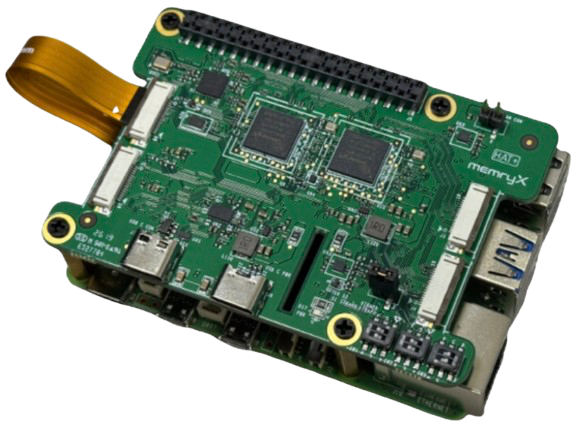
Cascade 100RAI Accelerator HAT+ Module
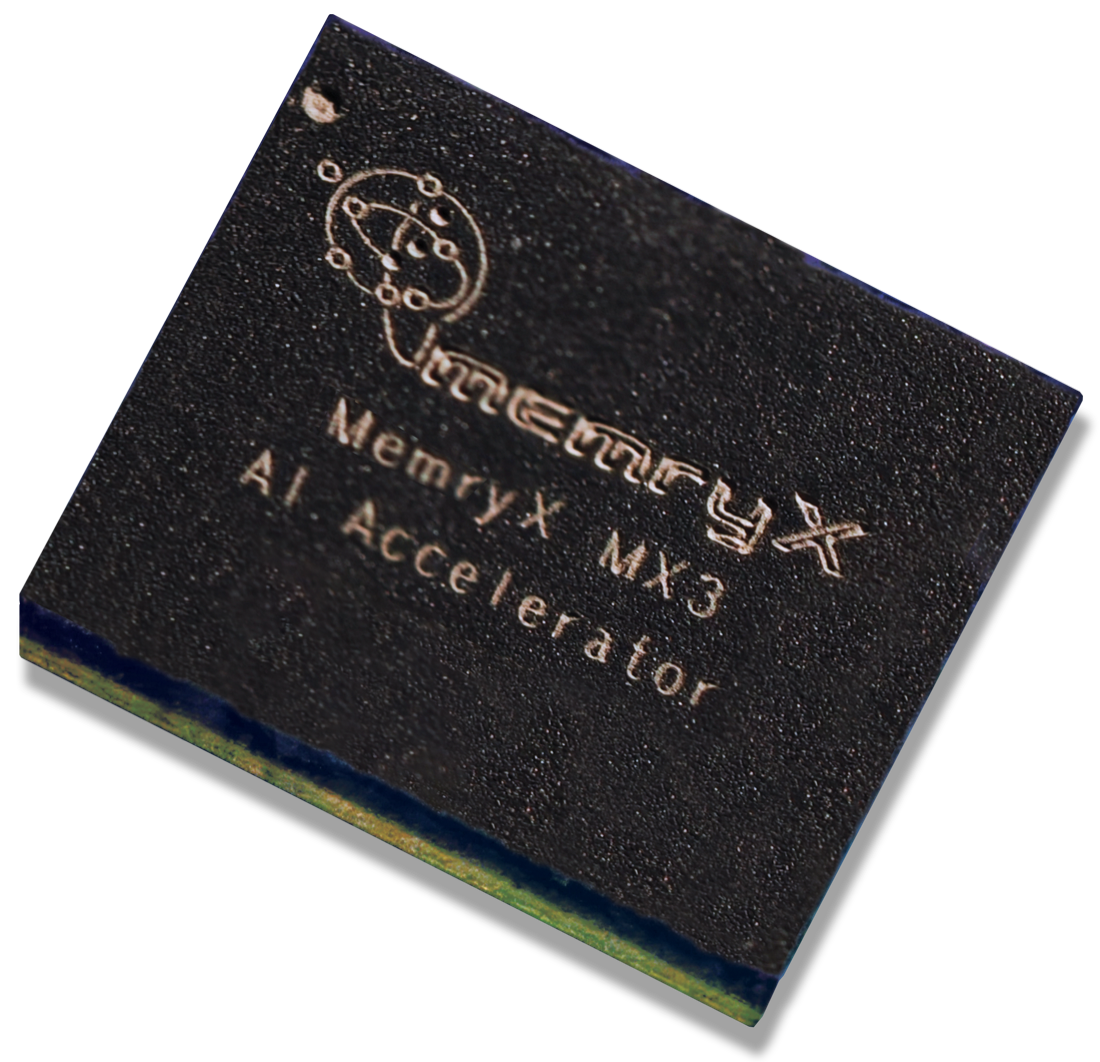
Two MX3 accelerators on a Raspberry Pi 5 HAT+ — the fastest way to prototype edge AI.


The Cascade 100R brings production-grade edge AI inference directly to the Raspberry Pi 5.
Engineered as a Raspberry Pi 5 HAT+ companion, the Cascade 100R offloads deep neural network computer vision models from the host CPU. It plugs straight into the Pi 5’s PCIe connector and 40-pin GPIO header — no external accelerator box, no separate power supply — turning a stock Pi 5 into a self-contained edge AI platform.
What the Pi gains
Two MX3 accelerators run real-time, batch-1 inferencing next to the Pi’s own CPU — without taking any of it.
*Versus the integrated capabilities of a Raspberry Pi 5.
A Pi 5 that runs real models
Everything needed to go from a stock Raspberry Pi to a working inference pipeline — in an afternoon.
Drops onto any Raspberry Pi 5
Standard HAT+ mounting, powered by the Pi over its native connectors. Set up and running in minutes — no extra cabling, no proprietary driver.
Self-hosted development kit
The full toolchain runs on the Pi itself. Example applications are published on GitHub and clone straight onto the board.
Hundreds of verified models
One-click compile in Model Explorer. No retraining, no quantization step — the compiler maps the model onto the fabric as it is.
No external DRAM
21 MB of on-chip weight storage keeps cost, power and latency low — and removes the memory bottleneck entirely.
Why it behaves predictably
At-memory computing and a pipelined dataflow design — the same architecture that runs from a sensor to a rack.
No retraining required
MX3 floating-point activations give high accuracy through direct recompilation of the model — the network you trained is the network that runs.
Consistent batch-1 latency
A low-latency pipelined dataflow design with all memory on the accelerator. System bottlenecks are fully mitigated and the host carries no AI processing requirement.
Native Pi 5 integration
A true HAT+ module: power and PCIe data over the Pi’s own connectors. The two MX3 accelerators present to the host as a single logic unit over the PCIe link.
At-memory dataflow
At-memory computing and a dataflow fabric deliver high throughput and the lowest energy per inference for streaming inputs.
Concurrent model execution
Run CNN detectors, vision transformers, segmentation, pose and speech models concurrently on a single module, up to 21 MB of combined weights.
Prototype to field
The same module suits experimentation, rapid prototyping, field deployment and adding AI vision to shipping Raspberry Pi–based products.
Cascade 100R at full detail
Built for the field, not the bench
The toolchain is a free download
Nothing gated, nothing to request. Flash the Pi, install the SDK, compile a model.
Get started guide
Install the SDK, run your first inference on the Pi, then compile your own model.
developer.memryx.com →eXamples
Working reference applications — clone one onto the board and watch it run.
github.com/memryx →Community forum
Ask questions, share builds and get answers from MemryX engineers.
community.memryx.com →